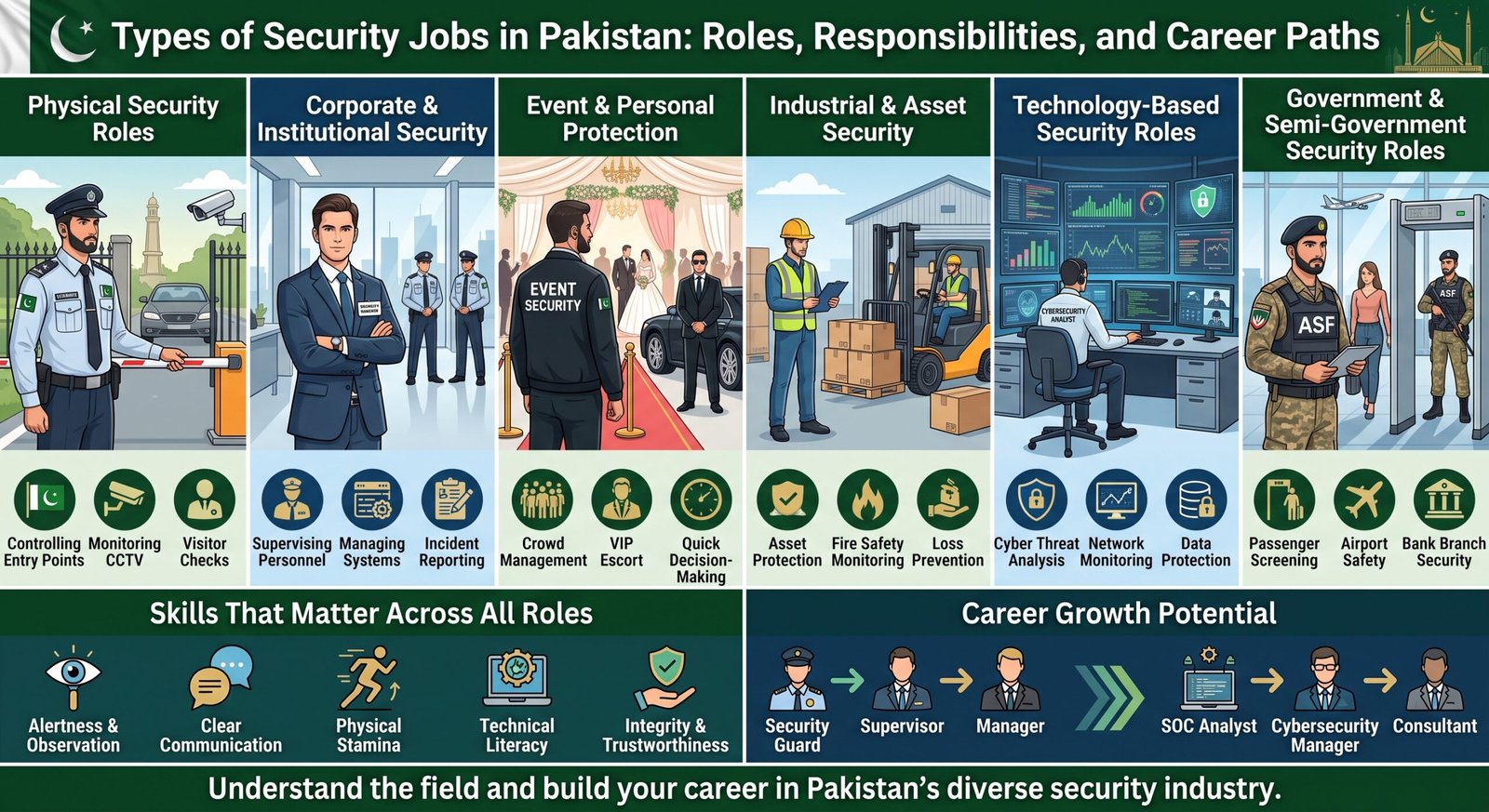
Types of Security Jobs in Pakistan: Roles, Responsibilities, and Career Paths
The word “security job” means very different things depending on the industry. A bank guard, a cybersecurity analyst, and a VIP bodyguard all fall under the same broad category, yet their daily responsibilities, required skills, and career paths are completely different. For anyone exploring a career in this field, understanding these distinctions is the first step toward choosing the right specialization.
This article breaks down the major types of security jobs available in Pakistan today, explaining what each role actually involves, the skills needed, and where each career path can lead.
- Physical Security Roles
Physical security remains the backbone of the security industry. These jobs focus on protecting people, property, and assets through direct presence and monitoring.
Security Guard
The most widely available role. Duties include controlling entry and exit points, checking visitor identification, monitoring CCTV where applicable, and conducting regular patrols. This role is common in residential societies, retail stores, schools, and offices.
Gate/Access Control Officer
A more specialized version of the guard role, focused specifically on managing vehicle and pedestrian access at gated facilities, factories, or housing societies. Strong attention to detail and record-keeping is essential.
Patrol Officer
Patrol officers are responsible for moving through assigned zones — often in vehicles — to check for suspicious activity across multiple sites. This role is common with private security agencies that serve several clients in one area. - Corporate and Institutional Security
These roles exist within structured organizational settings and often come with more defined hierarchies and benefits.
Security Officer
Found in banks, telecom companies, and corporate offices, this role involves supervising guards, managing access control systems, coordinating with law enforcement when needed, and handling incident reports. A security officer typically reports to a security manager.
Security Supervisor
Supervisors oversee teams of guards across one or more locations, manage duty rosters, conduct on-site training, and ensure compliance with company security policies.
Security Manager
A senior-level role responsible for designing and implementing an organization’s overall security strategy, managing budgets, liaising with police and emergency services, and overseeing all security staff. - Event and Personal Protection Security
This category deals with protecting individuals or managing security at temporary gatherings.
Event Security Personnel
Responsible for crowd control, bag checks, and managing entry at concerts, weddings, and corporate events. Quick decision-making and physical fitness are valuable here.
Close Protection Officer (Bodyguard)
Provides direct, personal security to high-profile individuals such as executives or public figures. This role often requires prior law enforcement or military experience, along with specialized close-protection training. - Industrial and Asset Security
Factories, warehouses, and construction sites require a different security approach focused on asset and worker safety.
Industrial Security Guard
Monitors entry and exit of goods, vehicles, and workers, while also watching for fire hazards and unsafe practices on factory floors.
Loss Prevention Officer
Common in large retail chains and warehouses, this role focuses specifically on preventing theft, both from external sources and internal employees, often through a mix of observation and inventory audits. - Technology-Based Security Roles
As businesses digitize, demand for technical security expertise has grown sharply in Pakistan, particularly in banking, telecom, and IT sectors.
Cybersecurity Analyst
Monitors networks for threats, investigates security breaches, and implements protective measures against hacking and data theft. Requires a background in computer science or IT, along with familiarity with security tools.
SOC (Security Operations Center) Analyst
Works within a dedicated team that continuously monitors an organization’s systems for suspicious activity, often in shifts, using specialized monitoring software.
CCTV/Surveillance System Operator
Focuses specifically on monitoring camera feeds across a facility, flagging unusual activity in real time, and maintaining surveillance equipment.
IT Security Consultant
An advisory role, often freelance or contract-based, helping organizations design secure IT infrastructure and conduct vulnerability assessments. - Government and Semi-Government Security Roles
Pakistan’s public sector also offers structured security career paths.
Airport Security Officer
Employed through agencies like the Airport Security Force (ASF), these officers manage passenger screening, baggage checks, and overall airport safety protocols.
Bank Security Guard (State-Regulated)
Banks in Pakistan are required to maintain licensed armed or unarmed guards depending on branch size and location, often coordinated through approved security agencies.
Skills That Matter Across All Security Roles
While each role has its own specific requirements, a few core skills are valued across almost every security job in Pakistan:
Alertness and observation: The ability to notice unusual behavior or irregularities quickly.
Clear communication: Especially important when coordinating with team members or reporting incidents.
Physical stamina: Relevant for guard, patrol, and event roles requiring long shifts or standing duty.
Technical literacy: Increasingly important even in traditional roles, as CCTV systems and digital access logs become standard.
Integrity and trustworthiness: Since security personnel are often given access to sensitive areas and information, a clean record and reliable character are non-negotiable.
Career Growth Across Security Fields
One advantage of the security industry is that career growth is rarely a dead end. A guard with consistent performance can move into supervisory roles within a few years. Similarly, an IT graduate starting as a SOC analyst can progress toward becoming a cybersecurity manager or consultant. Choosing a specialization early — whether physical, corporate, or technical — helps in building relevant experience and certifications faster.
Final Thoughts
Security jobs in Pakistan are far more diverse than they might initially appear. From frontline guard duty to advanced cybersecurity roles, each specialization comes with its own skill requirements, work environment, and growth trajectory. Understanding these distinctions allows job seekers to choose a path that matches their strengths, whether that’s physical presence and vigilance or technical expertise in digital security.
Leave a Reply